Fabric data agents let people ask questions about your organisation's data in plain English and get answers back, without writing a query or building a report. They're one of the most talked-about features in Microsoft Fabric, and they're now generally available.
This guide explains what a data agent does, what you need to run one, what it costs in Australia, the data residency question Australian organisations need to answer first, and how to prepare your data so the answers are right. It's based on Microsoft's documentation as updated in October 2026. Data agents are changing quickly, so check Microsoft's current guidance before you start.
What a Fabric data agent is
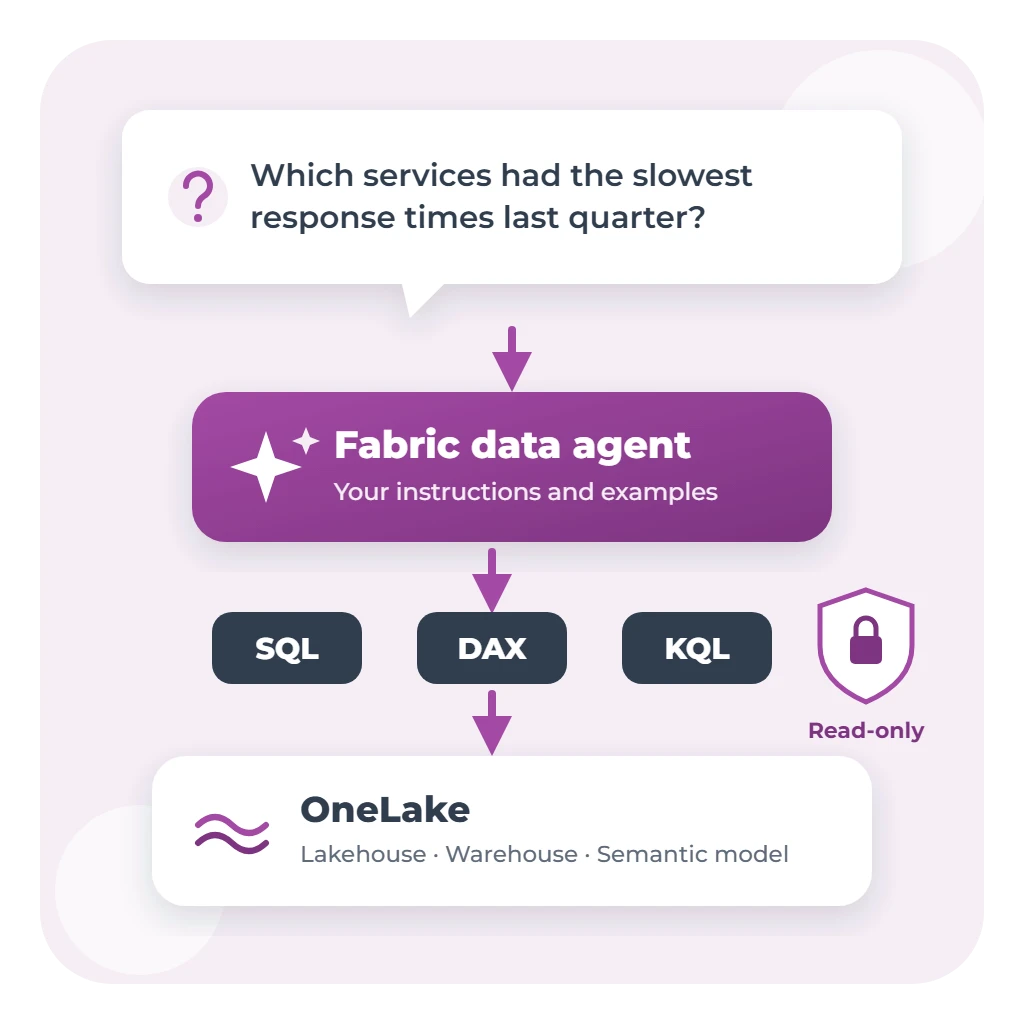
A data agent sits on top of data you already hold in Fabric's OneLake. When someone asks a question, the agent works out which source can answer it, writes a query, runs it and turns the result into a readable answer. It writes SQL for lakehouses and warehouses, DAX for Power BI semantic models and KQL for KQL databases.
- It's read-only. A data agent only generates queries that read data. It can't create, change or delete anything.
- It uses up to five sources in any combination: lakehouses, warehouses, Power BI semantic models, KQL databases, mirrored databases, ontologies and Microsoft Graph.
- You shape it. You choose the tables it can see, and add instructions and example questions so it uses your organisation's terms and picks the right source.
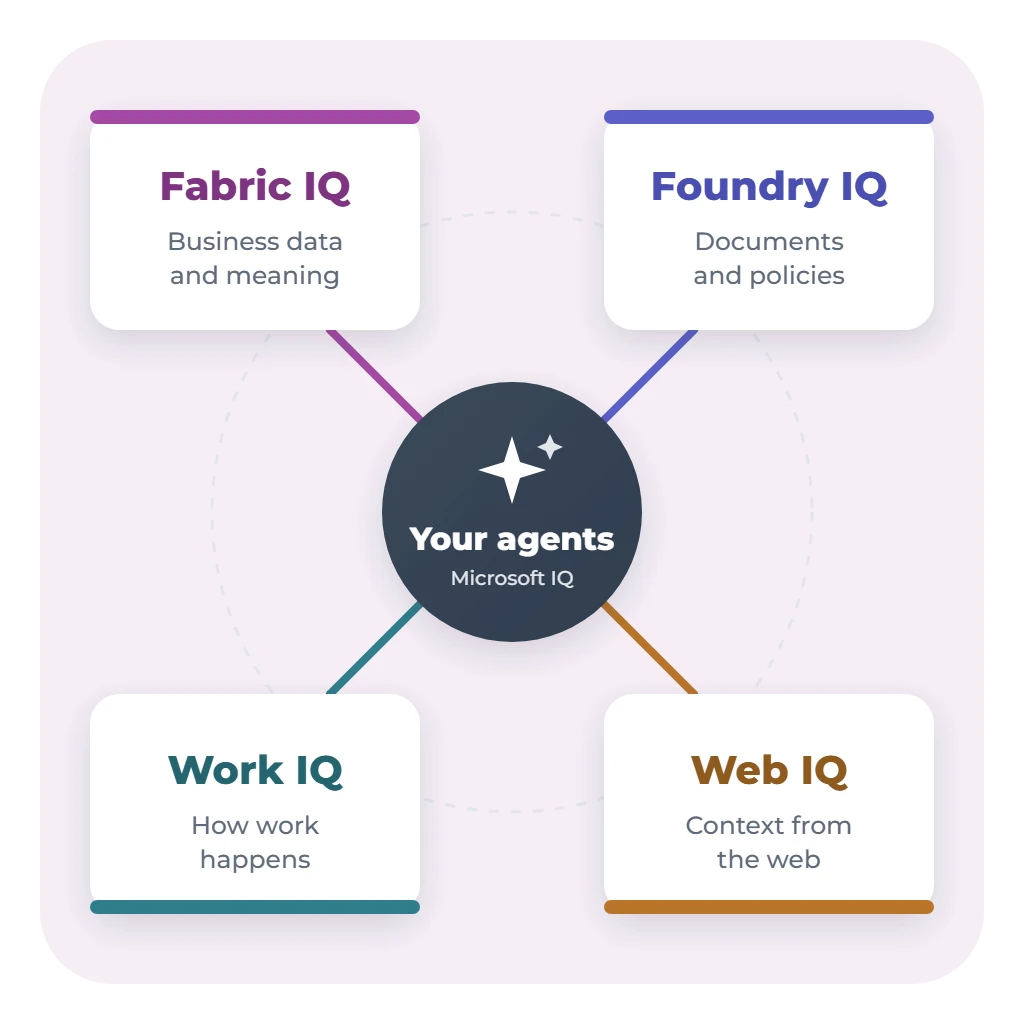
Data agents are part of Fabric IQ, Microsoft's layer of business context for agents. Our guide to Fabric IQ, Work IQ and Foundry IQ explains how the pieces fit together.
How it differs from Copilot
Copilot in Fabric comes ready-made and helps people work inside Fabric, for example by writing notebook code. A data agent is something you build and configure for a specific purpose, such as answering questions about customer requests or sales. Once published, it can be used inside Fabric, in Microsoft 365 Copilot and Teams, from Microsoft Copilot Studio and Azure AI Foundry, or by other AI tools through the Model Context Protocol (MCP).
What you need
- A paid Fabric capacity of F2 or larger, or a Power BI Premium capacity of P1 or larger with Fabric switched on.
- Copilot tenant settings switched on by a Fabric administrator, including the data residency settings below.
- Read access to the data sources for everyone who uses the agent.
- English questions. Other languages aren't currently supported.
- The same region. An agent can't query a source whose workspace sits on a capacity in a different region.
To use an agent from Microsoft 365 Copilot, Microsoft lists a "Microsoft Copilot license or Office 365 commercial subscription" and a user licence for each person, with the agent and Copilot in the same tenant.
The Australian catch: data residency
Data agents run on Azure OpenAI models, which Microsoft deploys to a select set of regions. For a capacity whose region is outside the EU data boundary and the United States, which includes Australia, Microsoft requires two tenant settings to be switched on:
- data sent to Azure OpenAI can be processed outside your capacity's geographic region, compliance boundary or national cloud instance; and
- data sent to Azure OpenAI can be stored outside it.
The stored data includes conversation history, which Microsoft keeps for up to 28 days unless the person clears it. Microsoft also notes that when an agent is used from Microsoft 365 Copilot, Copilot Studio, Azure AI Foundry or as an MCP server, its responses may leave Fabric's compliance boundary and region and fall under that service's own terms.
Make this a decision, not a default. Your data stays in Australia, but the questions and the context sent to the AI model may be processed and stored elsewhere. Ask your privacy officer to review it against your obligations under the Privacy Act and any contracts, decide which data the agent may use, and record the decision. For councils and other public bodies, this step comes before any pilot.
What it costs
There's no separate licence for a data agent: it uses your Fabric capacity. Usage is measured in tokens, the pieces of text sent to and from the AI model, including your instructions, example questions and conversation history, not just the question itself.
Microsoft's own example is a question with 2,000 input tokens and 500 output tokens, which uses 400 capacity-unit seconds. At Microsoft's Australian pay-as-you-go list price of A$0.2992 per capacity unit per hour, that's about 3 cents of capacity per question, before GST. Running the query the agent writes is charged separately, through the warehouse, lakehouse or semantic model it queries.
Agent requests run as background jobs, which Fabric spreads over time, so a burst of questions doesn't need a bigger capacity on its own. You'll find the usage under "AI Query" in the Capacity Metrics app. Microsoft can change these rates, so check current pricing before you budget. Our guide to what Microsoft Fabric costs in Australia covers capacity sizes.
Why answers depend on your data model
A data agent is only as good as the data and context you give it. It sees only the tables you select, and it answers in summary: responses are capped at 25 rows and 25 columns, so it's built for questions, not for exporting data.
- Start from curated data. Point the agent at a clean gold layer or a governed semantic model, not raw tables full of codes and duplicates.
- Name things clearly. The agent reads table and column names to decide what to query, so "Customer Request Date" beats "CR_DT".
- Write instructions. Explain your terms, such as what counts as an "open" request or which financial year you use, and which source answers which kind of question.
- Add example questions. You can add up to 100 question-and-query pairs per source. They aren't currently supported for semantic models, so a semantic model's names and descriptions matter even more.
This is where most of the work is, and it's the same work that makes Power BI reports trustworthy. Our article on why data modelling matters goes further.
Security and governance
- People only see what they're allowed to. The agent runs with each person's own credentials, and row-level and column-level security on semantic models still apply.
- Sharing an agent doesn't share the data. Each person still needs access to the underlying sources.
- Microsoft Purview applies. Data loss prevention and access policies can block queries, and agent conversations can be audited. Some of the Purview features for agents are still in preview.
- Manage it like other Fabric items. Agents support Git integration and deployment pipelines, so you can test changes before they reach users.
Limitations to plan for
- No documents: it can't read PDFs, Word files or text files, only tables.
- You can't choose or change the AI model behind it.
- Conversation history can be reset by service changes.
- Answers are summaries, capped at 25 rows and 25 columns.
A practical way to start
- Settle the data residency question with your privacy officer before anything else.
- Pick one subject area with a clear owner and a well-modelled source, such as customer requests, sales or project costs.
- Collect 20 real questions from the people who'll use it, and the answers they expect.
- Build, instruct and test. Select the tables, write the instructions and example questions, and check the agent against your 20 questions.
- Pilot with a small group, measure how often the answers are right, and improve before you roll it out more widely.
Not sure your data is ready? Our free 15-question AI Readiness Checklist shows where you stand. Our six-week AI Agent Pilot takes one process from idea to a working agent with measured results, and our Fabric Accelerator sets up the governed lakehouse and semantic model an agent needs. Or book a 30-minute call to talk it through.